
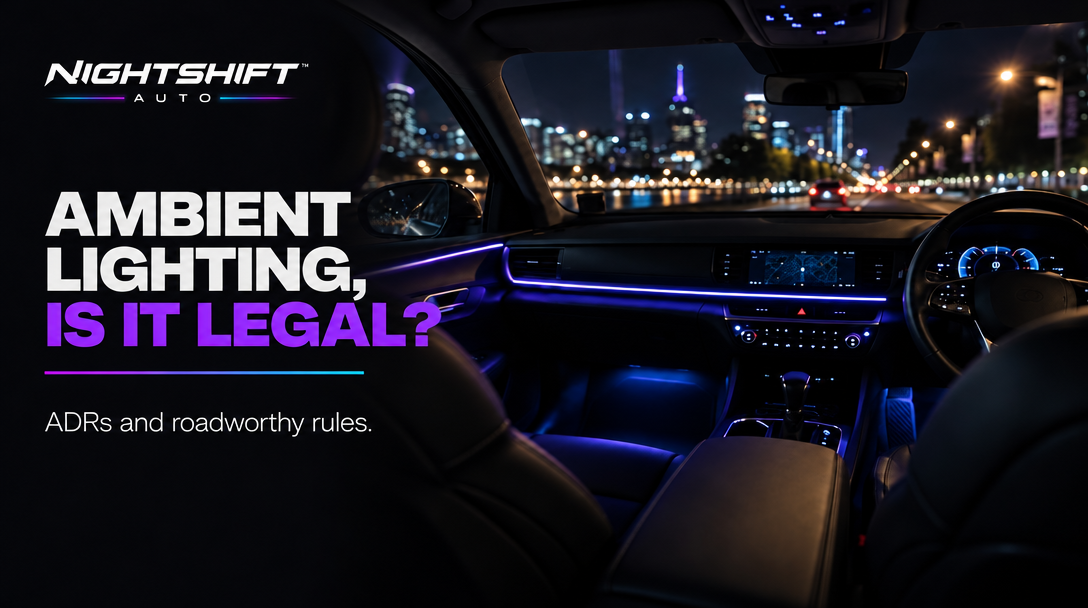
It's the first question everyone asks after seeing an ambient-lit interior: is that actually legal? The short answer is that interior ambient lighting is not banned in Australia — but the details sit across the Australian Design Rules, state and territory road rules, and roadworthy standards, and they are not identical everywhere.
Here's the honest version of what matters, and the checks to make before you rely on any of it.
What the rules are actually about
Vehicle lighting rules in Australia exist for two reasons: so other road users aren't dazzled or confused, and so your own vision isn't compromised. An ambient kit that stays inside the cabin and doesn't affect either is a very different proposition to a light visible from outside the car.
- Interior vs exterior. Lighting visible from outside the vehicle is regulated far more strictly than lighting contained within the cabin. Keep ambient lighting interior.
- Glare and reflection. Light that reflects in the windscreen or side glass can reduce the driver's vision at night. Brightness and placement are the controls here — aim strips along trim seams, not at glass, and keep the brightness low enough that nothing reflects.
- Colours reserved for emergency vehicles. Red and blue lighting visible from outside the vehicle can be confused with emergency signals. Avoid running those colours in any configuration visible from outside.
- Flashing or strobing. Animated modes that flash are a different category to a steady glow. A steady, dim interior light is the conservative setup.
Where the ADRs fit in
The Australian Design Rules are national standards that apply to vehicles when they're manufactured and first supplied. Aftermarket interior accessories like a plug-in ambient kit aren't "vehicle lighting" in the ADR sense the way headlights or tail lamps are — but state and territory road rules still govern how a vehicle can be used and modified on the road, and roadworthy inspections look at anything that affects safety.
In practice, the questions that matter for an ambient kit are the ones above: is it interior, does it create glare or reflections, and could its colour or behaviour be confused with something it isn't.
Roadworthy and insurance considerations
A plug-in kit that powers from a 12V socket or USB port and mounts with adhesive or trim-tucking doesn't modify the vehicle's structure or factory wiring, which keeps it well clear of the modification questions that arise with hard-wired electrical work. A fuse tap install is still reversible but touches the vehicle's electrical system, so it's a step further in — if you're not confident, that's the point where an auto-electrician is worth the money.
On insurance: modifications and accessories can matter to a policy. If your car is insured, financed or leased, a quick check with the insurer or finance provider costs nothing and settles it.
The responsible setup, in five lines
- Keep the lighting interior — nothing visible from outside the car.
- Keep brightness low enough that nothing reflects in the windscreen.
- Avoid red and blue in any configuration visible from outside.
- Use plug-in power (12V socket or USB) unless you're confident with a fuse tap.
- Set it up while parked, and don't adjust it while driving.
Both NIGHTSHIFT™ AMBIENT and NIGHTSHIFT™ AMBIENT PRO power from a 12V socket or USB and install without cutting factory wires — see the live product cards below for current pricing and what's included.
FAQ
Is interior ambient lighting legal in Australia?
Interior ambient lighting is not banned, but road rules vary by state and territory. Keep it interior, keep it dim enough to avoid windscreen reflection, avoid emergency colours visible from outside, and check your local rules.
Will an ambient kit fail a roadworthy?
A plug-in interior kit that doesn't create glare, isn't visible from outside and doesn't modify factory wiring is a very different case to non-compliant exterior lighting. If an inspection is coming up, the kit unplugs and removes.
Can I run any colour I want?
Inside the cabin you have wide latitude; red and blue visible from outside the vehicle are the colours to avoid, as they can be confused with emergency vehicles.

